










Culture Ministry Marks 'Samvidhan Hatya Diwas'; Global Democracy Rankings Raise Questions
The Ministry of Culture commemorated Samvidhan Hatya Diwas marking 50 years of the Emergency, while international democracy rankings continue to raise questions about India's democratic performance.
Culture Ministry Marks 'Samvidhan Hatya Diwas'; Global Democracy Rankings Raise Questions
Say 'No to Emergency'
CNB WORLD TIMES
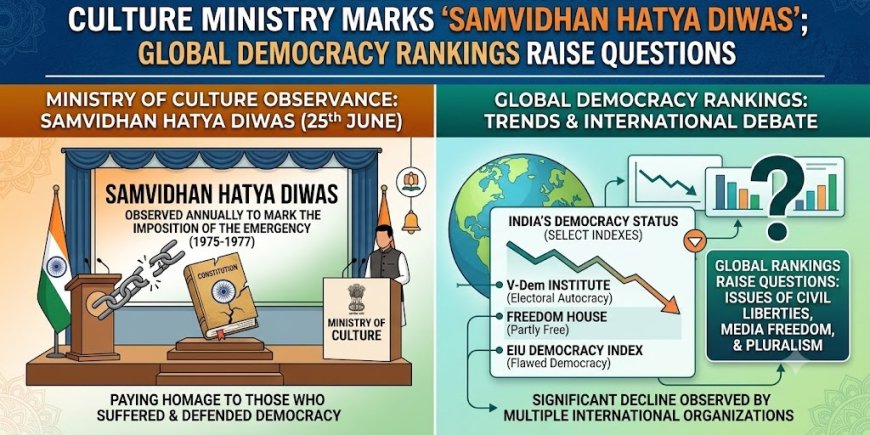
New Delhi: The Ministry of Culture commemorated 'Samvidhan Hatya Diwas' through a special programme at the Centre for Cultural Resources and Training (CCRT) in New Delhi, marking 50 years since the Emergency was imposed in 1975. The event, led by Union Minister for Culture and Tourism Shri Gajendra Singh Shekhawat, highlighted the importance of democracy, constitutional values, and citizens' rights.
Addressing the gathering, Shri Shekhawat said democracy is embedded in India's identity and extends beyond elections to include freedom of expression, the right to dissent, a free media, the dignity of citizens, and the supremacy of the Constitution. He described the Emergency as a reminder of the importance of safeguarding democratic institutions and constitutional freedoms.
The programme featured the exhibition "Long Live Democracy," a showcase of the Digital District Repository (DDR) documenting India's freedom struggle, a cultural performance titled "Musical Tribute to the Spirit of Democracy – From Silence to Voice, From Darkness to Dawn," documentary screenings, and a felicitation ceremony honouring veteran freedom fighters, researchers, and contributors to the DDR initiative.
Eminent journalist and author Shri Ram Bahadur Rai, who was imprisoned during the Emergency, shared his experiences and reflected on the resilience of India's democratic institutions. The event also displayed artworks created under the Ministry's nationwide Seva Parv initiative themed "Viksit Bharat ke Rang, Kala ke Sang."
Democracy Celebration Draws Scrutiny
While the government used the occasion to celebrate India's democratic traditions and remember the Emergency, the event has also prompted renewed discussion about the country's standing in international democracy assessments.
Several global organisations have reported a decline in India's democratic indicators over the past decade, raising concerns about civil liberties, press freedom, institutional independence, and government accountability.
According to the Economist Intelligence Unit (EIU) Democracy Index, India is classified as a "Flawed Democracy," with a score of approximately 7.23 out of 10. The index acknowledges India's strong electoral framework but points to challenges such as reduced political participation, media constraints, and governance issues.
Similarly, Freedom House categorises India as "Partly Free," assigning it a score of 62 out of 100. The organisation cites concerns related to civil liberties, treatment of minorities, restrictions affecting journalists, and pressure on government critics.
The Varieties of Democracy (V-Dem) Institute classifies India as an "Electoral Autocracy," citing a decline in judicial independence, civil society freedoms, and liberal democratic institutions over recent years.
Despite these assessments, India continues to be recognised as the world's largest democracy, with consistently high voter participation, regular elections, and peaceful transfers of power. However, the contrasting assessments have sparked debate over the gap between official celebrations of democratic values and the concerns expressed in international democracy indices.
Political observers note that while commemorating the Emergency serves as a reminder of the importance of protecting constitutional rights, it also highlights the need for continuous efforts to strengthen democratic institutions, safeguard freedom of expression, ensure media independence, and reinforce institutional accountability.
The differing perspectives underscore the broader debate over the health of Indian democracy and the challenges involved in balancing democratic traditions with evolving governance practices.
What's Your Reaction?