






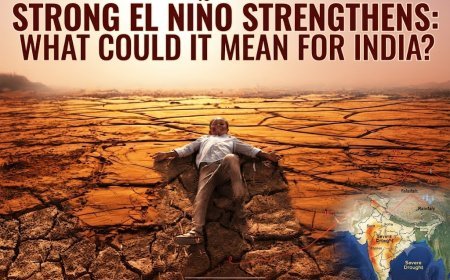
















Strong El Niño Strengthens: What Could It Mean for India?
El Niño is strengthening in the Pacific. The climate event may affect India’s monsoon, rainfall and temperatures in the coming months.
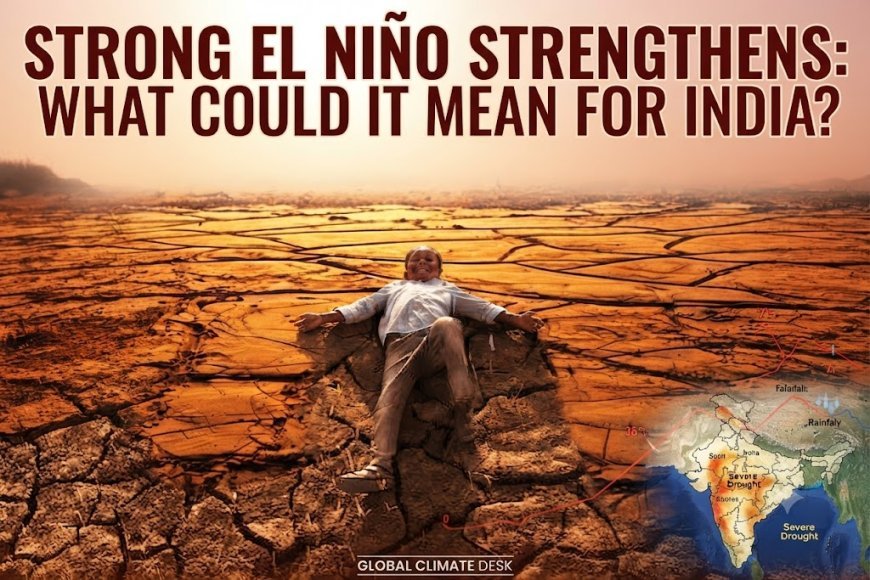
Strong El Niño Strengthens: What Could It Mean for India?
El Niño strengthens in the Pacific
CNB WORLD TIMES
A strong El Niño event is currently developing in the tropical Pacific Ocean. According to the Australian Bureau of Meteorology, El Niño is firmly established and continues to strengthen.
The latest relative Niño3.4 index for the week ending 13 September 2026 stood at +2.51°C, far above the El Niño threshold of +0.80°C. The Bureau says most climate models forecast further warming, with many models indicating a peak above +3.0°C during late spring or summer. (Bureau of Meteorology)
The US Climate Prediction Center has also reported that El Niño is strengthening and has placed the ENSO system under an El Niño Advisory. It gives a greater than 90% chance of a very strong El Niño during the Northern Hemisphere autumn and winter of 2026–27. (Climate Prediction Center)
What is El Niño?
El Niño is a climate phenomenon in which sea-surface temperatures become unusually warm across parts of the central and eastern tropical Pacific Ocean.
The warming of the Pacific can affect atmospheric circulation and influence weather patterns in different parts of the world.
During the current event, trade winds over parts of the tropical Pacific have weakened or reversed, while cloud and rainfall patterns have also changed. These oceanic and atmospheric changes are indicators of a developing El Niño. (Bureau of Meteorology)
Possible impact on India
El Niño is closely linked to variations in the Indian summer monsoon. Historical records from the India Meteorological Department show that several El Niño years have been associated with below-normal southwest monsoon rainfall, although the impact has varied from one event to another. (Mausam)
This means a strong El Niño can increase the possibility of weaker or uneven monsoon rainfall in parts of India. However, El Niño alone does not determine India's rainfall.
Other factors, including the Indian Ocean Dipole (IOD), Madden-Julian Oscillation (MJO), ocean temperatures and atmospheric circulation, can also influence the Indian monsoon.
IOD is also being watched
The Indian Ocean Dipole is currently described as neutral by the Australian Bureau of Meteorology. However, the IOD index for the week ending 13 September was +0.65°C, above the positive IOD threshold of +0.4°C.
The Bureau says one observation above the threshold does not by itself confirm the beginning of a positive IOD event. Climate models suggest that a positive IOD could develop during the southern hemisphere spring, although there is uncertainty about its strength and duration. (Bureau of Meteorology)
A positive IOD can sometimes influence the effect of El Niño on Indian monsoon rainfall. Therefore, scientists are monitoring both phenomena together.
What could happen in the coming months?
Climate models indicate that the Pacific Ocean could continue warming during the coming months. The Australian Bureau of Meteorology says the current El Niño could persist into autumn 2027. (Bureau of Meteorology)
National Oceanic and Atmospheric Administration (NOAA)'s September 2026 assessment also says the event is strengthening and could become a very strong El Niño during late 2026 and early 2027. (Climate Prediction Center)
What does it mean for India?
For India, the main concern is the possible influence on rainfall and temperature patterns.
A strong El Niño may increase the risk of:
· Below-normal rainfall in some regions.
· Uneven distribution of monsoon rainfall.
· Longer dry periods in some areas.
· Higher temperatures in certain periods.
· Possible effects on agriculture and water availability if rainfall becomes deficient.
However, these are potential climate impacts, not definite outcomes. India's actual weather will depend on several interacting climate factors.
Scientists continue to monitor the situation
The India Meteorological Department closely monitors ENSO, IOD and other climate factors because conditions in the Pacific and Indian Oceans can influence the Indian monsoon. IMD research also shows that the relationship between El Niño and Indian rainfall varies across regions and individual years. (Mausam Journal)
Therefore, the strengthening El Niño is an important climate signal, but its exact impact on India's rainfall and temperatures will become clearer through seasonal forecasts and continued monitoring.
The key message: El Niño is strengthening rapidly, but its eventual impact on India's weather cannot be determined from the El Niño index alone.
What's Your Reaction?