
























New UPI Charges Add to Burden of Existing Bank Fees
Proposed UPI merchant charges from October 15, 2026, along with minimum-balance, ATM, SMS and other bank fees, have raised concerns over the growing financial burden on ordinary customers and small businesses
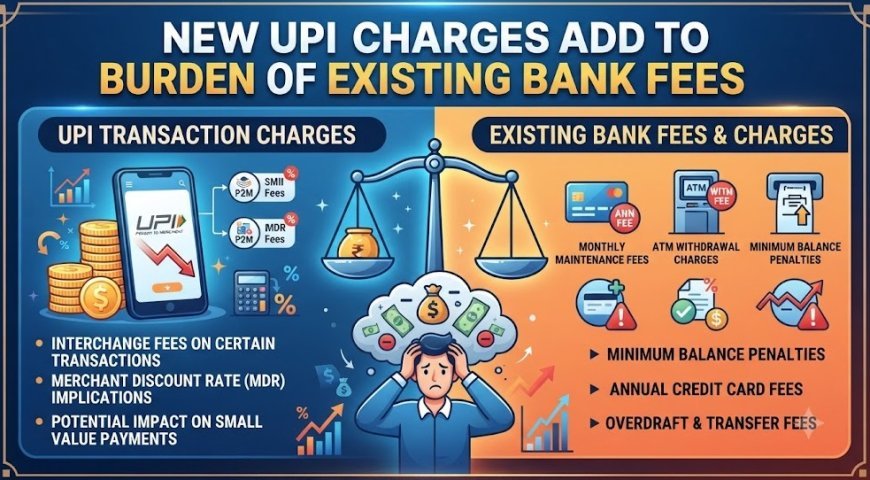
New UPI Charges Add to Burden of Existing Bank Fees
Person-to-person UPI transfers are not covered by this MDR.
CNB WORLD TIMES
Growing Financial Burden on Common People
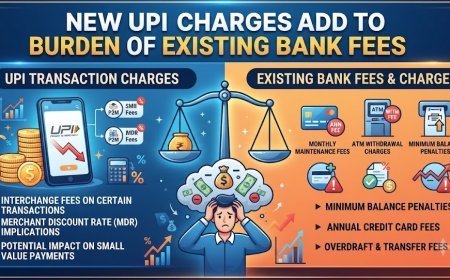
The proposed introduction of Merchant Discount Rate (MDR) on certain UPI payments has triggered a debate over the rising cost of banking and digital financial services. According to the Bank Employees Federation of India (BEFI), the new UPI charges could add to the financial pressure already faced by ordinary customers, small traders and street vendors.
BEFI raised the issue in a press statement issued on September 17, 2026. The organisation opposed the proposed charges and questioned the financial impact of introducing fees into an electronic payment system that has so far largely operated without MDR for ordinary UPI transactions.
1. Proposed UPI Transaction Charges
Under the revised UPI framework, effective October 15, 2026, eligible person-to-merchant (P2M) UPI transactions above ₹2,000 will attract an MDR of 0.4%, subject to a maximum of ₹300 per transaction. Person-to-person UPI transfers are not covered by this MDR. Small merchants receiving up to ₹1 lakh a month through UPI are also exempt under the announced framework.
For certain sectors, including railways, telecom, insurance and fuel, a flat MDR of ₹5 has been announced for transactions above ₹2,000. For transactions of ₹75,000 and above, the 0.4% MDR is capped at ₹300.
The government has said that banks and payment providers will be monitored to ensure that the MDR is not passed on to consumers. Therefore, the direct impact on customers will depend partly on how merchants and payment providers implement the new system.
2. Why the ₹300 UPI Cap Has Raised Questions
BEFI has compared the proposed UPI MDR ceiling with charges applicable to traditional electronic fund-transfer systems.
RBI's current framework says that banks cannot charge more than ₹50 for an outward RTGS transaction above ₹5 lakh, while NEFT charges for transactions above ₹2 lakh are capped at ₹25 for customers who are subject to charges. However, online NEFT transfers initiated by savings-bank account holders are generally free under RBI's 2020 directive. (Reserve Bank of India)
This comparison has led BEFI to question why a UPI transaction of ₹75,000 could carry an MDR of up to ₹300 when other electronic fund-transfer systems operate under much lower regulated customer charges.
However, there is an important distinction: MDR is a merchant-side payment-system charge and is not the same as a customer bank-transfer fee. The government has also stated that the new UPI MDR should not be passed on to consumers.
3. Minimum-Balance Charges
Another financial burden highlighted by BEFI is the range of charges associated with maintaining bank accounts.
Customers may face charges for failing to maintain prescribed minimum balances, depending on the type of account and the bank's applicable rules. RBI regulations specifically address minimum-balance requirements and charges for non-maintenance. (Reserve Bank of India)
For small traders, maintaining a current account can also involve minimum-balance requirements and other account-service costs. BEFI argues that such expenses can be significant for small businesses operating with limited margins.
4. ATM and Transaction Charges
Bank customers can also face charges associated with ATM usage after exceeding the number of free transactions permitted under applicable rules and bank policies.
Other banking-service charges can include transaction-related fees and charges for certain account services. RBI's customer-service framework recognises several categories of bank service charges, including ATM-related charges and other account services
5. SMS Alert and Other Service Charges
SMS transaction alerts and other banking services can also contribute to the overall cost of maintaining and operating a bank account. RBI guidelines have addressed the levy of SMS alert charges and advised banks to levy such charges on the basis of actual usage in relevant circumstances.
For customers who make frequent transactions, several small service charges can collectively become a noticeable expense over time.
6. The Burden on Small Merchants and Street Vendors
Small merchants and street vendors are an important part of India's UPI ecosystem. BEFI has argued that even when small vendors receive exemptions, they may continue to face other banking costs, including account-maintenance and transaction-related charges.
The new framework, however, provides an exemption for small merchants receiving up to ₹1 lakh per month through UPI, meaning the MDR will not apply to all small vendors.
The actual financial impact will therefore vary according to the merchant's monthly UPI receipts, transaction size, business category and bank-account arrangements.
7. UPI Versus Cash: A New Cost Debate
UPI became an important alternative to cash payments, particularly for small-value everyday transactions. The proposed MDR has therefore raised concerns among some merchant groups about whether additional payment-system costs could affect the attractiveness of digital payments.
At the same time, the government has argued that the new framework is intended to support the sustainability of the UPI ecosystem while protecting ordinary users and small merchants. Reuters reported that the new structure includes measures intended to support small merchants and strengthen the payment infrastructure.
8. BEFI's Opposition
BEFI has strongly opposed the proposed UPI charges and called on bank employees, trade unions and citizens to oppose the move. The organisation has also questioned whether the revenue generated through MDR could ultimately increase the cost of digital transactions for merchants and, indirectly, consumers.
BEFI's claims about the beneficiaries of the proposed charges and its wider allegations concerning corporate write-offs and government policy are the organisation's stated position and should be understood as such. They are not established facts merely because they appear in the press statement.
Overall Picture
The UPI debate is part of a broader discussion about the cost of banking services for ordinary customers. Minimum-balance requirements, ATM-related charges, SMS and other service fees can add to household and small-business expenses, while the proposed UPI MDR introduces a new merchant-side cost for certain higher-value payments.
The key issue for customers and merchants is whether these charges remain limited to the payment ecosystem or are eventually reflected in the prices of goods and services. The government has said that mechanisms will be used to prevent merchants from passing the MDR directly to consumers.
What's Your Reaction?