















NAMASTE Success Story: Four Sanitation Workers Become Entrepreneurs with Modern Machines
Learn how four sanitation workers from Nellore, Andhra Pradesh, became mechanised sanitation entrepreneurs under the NAMASTE Scheme, earning approximately Rs 37,000 each per month with financial assistance and modern machinery.
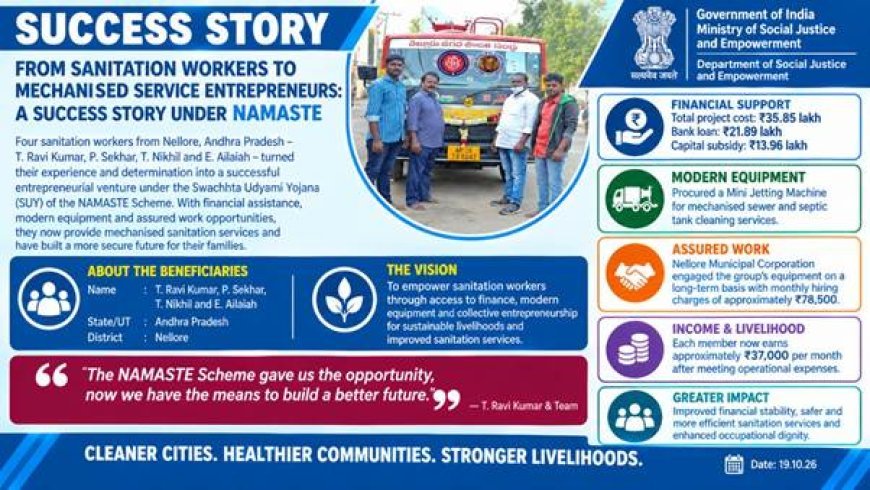
NAMASTE Success Story: Four Sanitation Workers Become Entrepreneurs with Modern Machines
CNB WORLD TIMES
From Sanitation Workers to Successful Entrepreneurs: How Financial Support and Mechanisation Transformed Four Lives in Andhra Pradesh
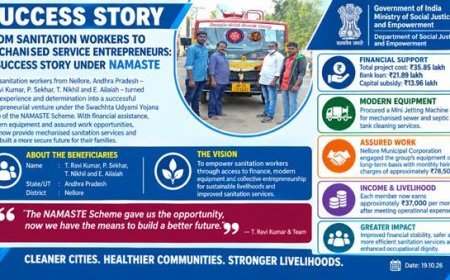
Four sanitation workers from Nellore, Andhra Pradesh, have turned their aspirations into reality by starting a mechanised sanitation service with the support of the Swachhta Udyami Yojana (SUY) under the NAMASTE Scheme. With financial assistance and modern equipment, T. Ravi Kumar, P. Sekhar, T. Nikhil and E. Ailaiah have improved their livelihoods, increased their earnings and taken a step towards financial independence.
From Financial Challenges to New Opportunities
T. Ravi Kumar, P. Sekhar, T. Nikhil and E. Ailaiah were engaged in sanitation work and wanted to improve their income and working conditions. They planned to adopt modern machines to provide safer and more efficient sanitation services.
However, the high cost of machinery and limited access to finance made it difficult for them to purchase equipment individually. Despite their experience in sanitation work, financial constraints prevented them from expanding their livelihood opportunities.
Their journey towards a better future began when they attended an awareness camp organised by the Nellore Municipal Corporation. At the camp, they learned about the Swachhta Udyami Yojana (SUY) under the NAMASTE Scheme, which supports sanitation workers in establishing mechanised sanitation enterprises.
The scheme provided an opportunity for the four workers to join hands and start their own business.
Financial Assistance Helps Them Buy Modern Machinery
With the support of a bank loan and an upfront capital subsidy, the group purchased a Mini Jetting Machine to provide mechanised sewer and septic tank cleaning services.
The total project cost was Rs 35.85 lakh. Of this amount, Rs 21.89 lakh was financed through a bank loan, while Rs 13.96 lakh was provided as a capital subsidy.
This financial support helped the beneficiaries overcome the initial investment barrier and acquire modern sanitation equipment that would have been difficult for them to purchase individually.
Regular Income Brings Financial Stability
After purchasing the machine, the group secured a long-term equipment hiring arrangement with the Nellore Municipal Corporation. The corporation pays approximately Rs 78,500 per month to hire the equipment.
This arrangement has provided the four beneficiaries with a regular source of income and a more stable livelihood.
After meeting operational expenses, each member earns approximately Rs 37,000 per month. The increased income has strengthened their financial position and helped them meet their families’ needs.
From Traditional Sanitation Work to Mechanised Entrepreneurship
The initiative has enabled the four beneficiaries to move beyond the limitations of traditional sanitation work and become owner-operators of modern sanitation equipment.
Mechanisation supports safer and more efficient sanitation operations while reducing dependence on conventional manual methods. Working together has also helped the beneficiaries overcome financial barriers and build a sustainable livelihood.
Their journey demonstrates how access to finance, modern machinery and regular work opportunities can help sanitation workers become entrepreneurs and improve their quality of life.
NAMASTE Creates a Path Towards a Better Future
Supported during 2021–22, the success story of T. Ravi Kumar, P. Sekhar, T. Nikhil and E. Ailaiah highlights the role of the Swachhta Udyami Yojana under the NAMASTE Scheme in promoting economic empowerment among sanitation workers.
By facilitating access to capital and mechanised equipment, the initiative has helped the four beneficiaries strengthen their livelihoods, improve their earnings and enhance their occupational dignity.
Their experience shows how collective entrepreneurship and mechanisation can create sustainable business opportunities for sanitation workers while contributing to safer and more efficient sanitation services.
Their journey is an example of how the right financial support, modern technology and collective effort can turn challenges into opportunities and help sanitation workers build a more secure future for themselves and their families.
What's Your Reaction?